Abstract
nprcgenekeepr provides genetic tools for primate-colony management – studbook quality control, pedigree construction, genetic value analysis, and breeding-group formation – as an R package with a Shiny front end and an exposed API. Between its two most recent CRAN submissions (v1.0.8, 2025-07-25, through v2.0.0, 2026-07-09; 512 non-merge commits), the package underwent a substantial modernization: a nine-phase, vertical-slice migration (each phase shipping a complete, working slice of the application rather than a partial layer) completed a modular Shiny rewrite – begun as an unfinished scaffold in December 2025, before this migration itself began – and retired the original monolithic Shiny application it was built to replace (ten R/mod*.R modules, 4,731 lines including appUI.R/appServer.R). Thirteen curated new capabilities shipped alongside it, spanning species-aware parent identification, more accurate uncertainty reporting in Genetic Value Analysis, and two new Shiny dashboards. The test suite grew from 132 to 257 files, and its browser-driven end-to-end layer went from present-but-inert to executable and behavior-verifying. Every session in the effort, including this article’s own drafting, was directed by Claude Code (Claude CLI) under a written, enforced development protocol – strict red-green-refactor TDD for production code (defined in Section 4, Section 6), single-deliverable sessions, and a durable, append-only correction ledger – rather than open-ended prompting. This article documents that transformation quantitatively: every claim traces to a commit, CHANGELOG.md entry, or frozen extraction, for readers evaluating the package itself, its testing rigor, or its AI-assisted development process.
Introduction
Between its two most recent CRAN submissions – v1.0.8 (4548aa1b, 2025-07-25) and v2.0.0 (8ca8bb24, 2026-07-09) – nprcgenekeepr changed enough to warrant a written account of the work, not just a version-number bump. This article documents that transformation for domain experts, other primate-center bioinformatics groups, CRAN reviewers, and potential contributors: what changed, and how it was built.
(v1.0.8 was submitted 2025-07-25 and published on CRAN within about a day, but was archived by CRAN on 2025-07-29 – “as issues were not corrected in time,” per CRAN’s own archival note, though no corresponding problem was found in the published check results. The maintainer did not notice the archival until 2026-01-15; by then the originally submitted code was no longer current, and – having just begun using Claude Code CLI – development went directly into the larger modular rewrite that became v2.0.0 rather than repairing and resubmitting v1.0.8. This is why CRAN and GitHub Releases still list v1.0.7, not v1.0.8, as the package’s prior public release.)
Four pillars structure the account. Section 1 describes completing a modular Shiny rewrite – begun as an unfinished scaffold before this project adopted Claude Code – via a nine-phase, vertical-slice migration that brought it to full parity and retired the original monolith. Section 2 describes the new analysis capabilities that shipped alongside that migration. Section 3 describes how the test suite grew and gained an executable, behavior-verifying, browser-driven layer. Section 4 describes the development process itself – every session in this effort, including the five sessions that drafted this article, was directed by Claude Code (Claude CLI) operating under a written, enforced protocol rather than open-ended prompting.
Scope. Every quantitative or dated claim in this article is bounded to the 512 non-merge commits between those two submission commits (4548aa1b..8ca8bb24) – not “since the project began.” As of this writing (2026-07-09), CRAN’s review of the v2.0.0 submission is still pending; nothing in this article depends on that outcome.
Section 1 – From Monolith to Modules: the Shiny Architecture Transformation
For nearly all of its life – including its last CRAN release, v1.0.7 – nprcgenekeepr shipped a single Shiny application, inst/application/: a single server.r (1,304 lines) plus a short ui.r (53 lines) that sourced eight separate uitp*.R panel files. In December 2025, before this project adopted Claude Code, a module-based rewrite (R/appUI.R, R/appServer.R, and a growing set of R/mod*.R files) began by hand as an unfinished scaffold, not a second working application. Over the following months it grew far enough, alongside the still-active monolith, that the two genuinely began to drift – different tab identifiers, different default parameters, a bug fixed in one but not the other – which this project’s own architecture audit flagged as its single highest-risk finding (XARCH-1) and its single biggest source of friction for adding new features. (Issue #27, open since 2022, tracked the long-standing intent to modularize; it predates the drift itself, and its own text doesn’t document the friction claim – that judgment is the audit’s.)
“Completing the conversion” meant bringing the modular app to full feature parity with the monolith, validating it end to end, and then retiring the monolith outright – not a gradual coexistence, a hard cutover. That work ran as a nine-phase, vertical-slice migration – each phase one TDD session (RED -> GREEN -> REFACTOR with phase gates), each phase leaving a working application behind it – from Session 22 to Session 35 (2026-06-03 to 2026-06-06).
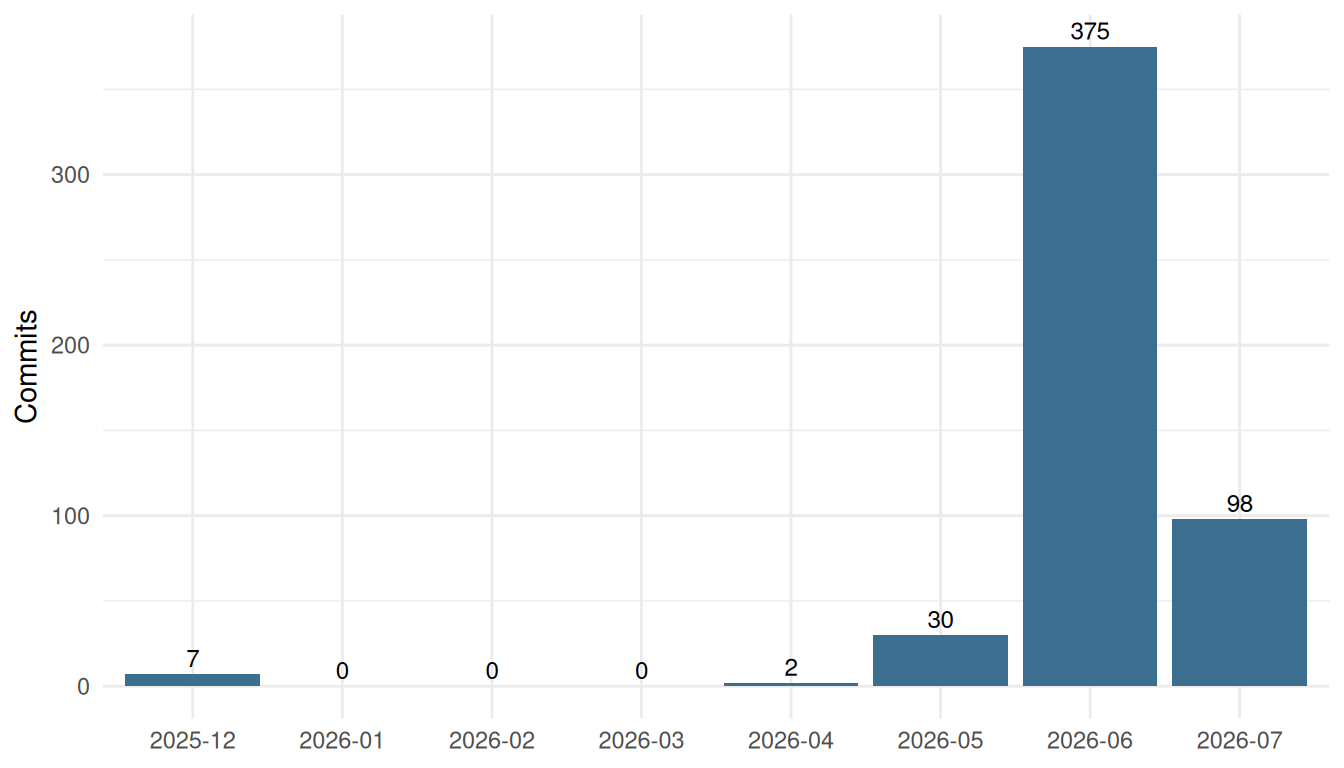
Figure 1 situates the migration inside the wider effort: after a handful of occasional, pre-methodology commits in December 2025, the project went fully dormant for three calendar months (January-March 2026, visible in the chart as zero-commit bars) before a sustained pace began once the SESSION_RUNNER methodology took hold in Session 1 (2026-05-30), peaking in June 2026 – the same month the module migration ran – and settling into a testing-and-release-hardening pace in July.
Architecture, before and after
Figure 2 contrasts the two designs directly. The monolith’s server.r was a single large reactive block reading and writing shared state through ordinary R variables in one scope. The modular app instead composes independent modXServer() functions, each returning a named list of reactive() closures; appServer() wires those returns into one shared <- reactiveValues(...) object and passes reactive(shared$...) down to the modules that need it – an explicit, if still informal, module contract.
The cutover was declared in Phase 9 (Session 35): runModularApp() became the canonical launcher, with runGeneKeepR() deprecated to a lifecycle::deprecate_soft()-aliased call to it (3db018d1), and, in its own standalone commit immediately after, inst/application/ – 17 files, including server.r, ui.r, and the eight uitp*.R panels – was deleted outright (24992e0b; docs/vignette updates and an unrelated fix followed in 53a9e5e0/a1618c48). Because deletion was its own commit rather than folded into the alias change, reverting the cutover – had the modular app proven insufficient – would have been a single git revert of 24992e0b, not an unpicking of nine phases of work. As of 2026-07-09, that revert was never needed. The alias direction reversed later, unrelated to this migration: issue #110 (Session 276, commit 1e64dd5d) made runGeneKeepR() canonical again and soft-deprecated runModularApp() in its place – the state Figure 2’s caption describes as current.
The modules today
Table 1 lists all ten R/mod*.R files that exist in the package as of 2026-07-09; together with R/appUI.R and R/appServer.R they total 4,731 lines. Six of the ten – modInput, modPedigree, modPyramid, modGeneticValue, modSummaryStats, and modBreedingGroups – came out of the nine-phase migration itself. modGvAndBgDesc was mounted early in that migration (Phase 2, Session 23). modORIPReporting exists and is wired into both appUI() and appServer(), but only mounts at runtime for an ONPRC site configuration (shouldShowOripTab()), matching the migration plan’s explicit decision to keep it unwired-but-undeleted rather than build out its functionality. modGeneticDiversity and modPotentialParents are not migration artifacts – they were added afterward, as new capabilities in their own right; Section 2 (new features) covers them.
The nine-phase migration
Table 2 summarizes all nine phases. Phases 1, 2, and 9 are anchored to directly-verified commit shas; phases 3 through 7 are verified only by their CHANGELOG.md session-close-out entries – the source migration plan does not quote a sha for those phases, and this article does not invent one. Phase 8 deserves a specific correction against an earlier, looser characterization of this migration (“phases 1-9 all marked DONE”): it was not a single-session parity phase like its neighbors. It expanded into its own four-session subplan (8a-8d, Session 31-34, issue #39, closed at Session 34) and, after that, a further seven-part hardening pass (8e-1 through 8e-7, Session 37-50, issue #40) – documented in the subplan’s own body text and in CHANGELOG.md, not visible from the migration plan’s phase header alone. Phase 9, by contrast, was the irreversible step: declaring the modular app canonical and deleting the monolith outright, which is why it carries a HIGH risk rating even though it shipped in a single session.
Section 2 – New Capabilities in 2.0.0
With the modular architecture in place (Section 3), the same v1.0.8 -> v2.0.0 range also shipped new analytical capability, covered next. Between the v1.0.8 and v2.0.0 CRAN submissions, 47 GitHub issues closed inside the 512-commit range (2025-07-26 to 2026-07-09). Most of those closes were not new capability: fixes to existing behavior, issue-hygiene closes verifying functionality that already existed before the range (issue #34, for example, found qcStudbook() already integrated into modInput from pre-migration work and simply closed the paper trail about five months later, with no code change), and internal process items (lint configuration, roxygen documentation harmonization, codecov config consolidation) that belong to no reader-facing section of this article. Table 3 curates the 13 of 47 (28%) that shipped a capability an analyst or maintainer can actually use – a genuinely new statistic, a new Shiny tab, or a materially different default – each traced to its closing issue number and the session(s) that implemented it.
Table 3 groups into three loose clusters, covered below: parent identification, Genetic Value Analysis uncertainty, and two new Shiny dashboards.
Parent identification grows principled and species-aware
The single largest cluster of new capability – five of the thirteen curated features – reworked how the package identifies and reasons about parents. It started narrowly: issue #31 replaced a fixed dam-exclusion heuristic in getPotentialParents() with a window derived from each species’ actual gestation length (Session 74, commit 0eeee3f6), and the Potential Parents Shiny tab (issue #48, Session 80-81) turned that package-level logic into an app feature for the first time – previously, getPotentialParents() had no UI at all.
That work exposed a bigger gap: the package had no first-class notion of species. Issue #46 (Session 165-169) added a species pedigree column and made the gestation window and its UI defaults species-keyed instead of assuming rhesus macaque throughout. Issue #73 (Session 182-189) went further, adding a 14-species reproductive-parameter table (minimum breeding ages, gestation length) with user-configurable overrides, feeding both Genetic Value Analysis and the Potential Parents tab. Issue #119 (Session 303-307, five slices) closed the loop: a single flat minParentAge = 2 default – inconsistent with the species-aware breeding-age table introduced for #73 – was replaced end to end with sex- and species-specific minSireAge/minDamAge floors across QC, candidate-matching, and the Shiny UI.
Genetic Value Analysis becomes more accurate about uncertainty
Four features changed what Genetic Value Analysis reports, not by adding a new tab but by making existing statistics more accurate or more explicit about their own limits. Issue #9 (Session 176-181, three slices) stopped animals with an unknown parent from silently inflating their own mean kinship and falsely top-ranking as “unique” founders – their parentage is now classified and the displayed rank corrected accordingly. Issue #76 (Session 191-192), filed as a direct follow-on to #9, carried the same logic to genome uniqueness: a both-unknown-parentage “Undetermined” founder now reports gu = 0 instead of a number with no real biological signal behind it. Issue #82 (Session 208-209) added a fgSE column next to fg in reportGV()’s output, so the founder genome equivalents estimate ships with its own sampling uncertainty rather than a bare point value. Issue #118 (Session 310-313, four slices) added the largest single statistic of the range: effective population size (Ne) estimates, computed three ways (gene diversity, demographic sex-ratio, and variance effective size) – a colony-level number distinct from, and generally smaller than, simple census count.
Two new dashboards, and a long-dormant module unlocked
The remaining features are new Shiny surfaces. Issue #112 (Session 280-283, four slices) added the Genetic Diversity tab: a modGeneticDiversity module rendering a group x metric red/yellow/green heatmap that combines four independent signals (proportion of low genetic value, Indian-origin status, production status, and inbreeding risk) into one at-a-glance view per breeding group. Issues #47 and #49 (Session 83-84) mounted modORIPReporting – a module that had existed, complete but never wired into the app, since the original Shiny-module migration (Section 3) – as an ONPRC-only grant-reporting tab, gated by shouldShowOripTab() so it does not appear for other sites. Together with the Potential Parents tab above, three of the ten modules listed in Table 1 trace their existence, or their activation, to this section’s work rather than to the migration itself.
Two smaller fixes round out the curated set (Table 3): issue #35 (Session 68-69) extended the Pedigree Browser’s focal-animal trim to include descendants, not just ancestors; and issue #44 (Session 70-72) replaced eight scattered literal "U"-prefix checks with a single configurable auto-generated-ID format, defaulting to the prior behavior unconfigured.
Section 3 – Testing at Scale
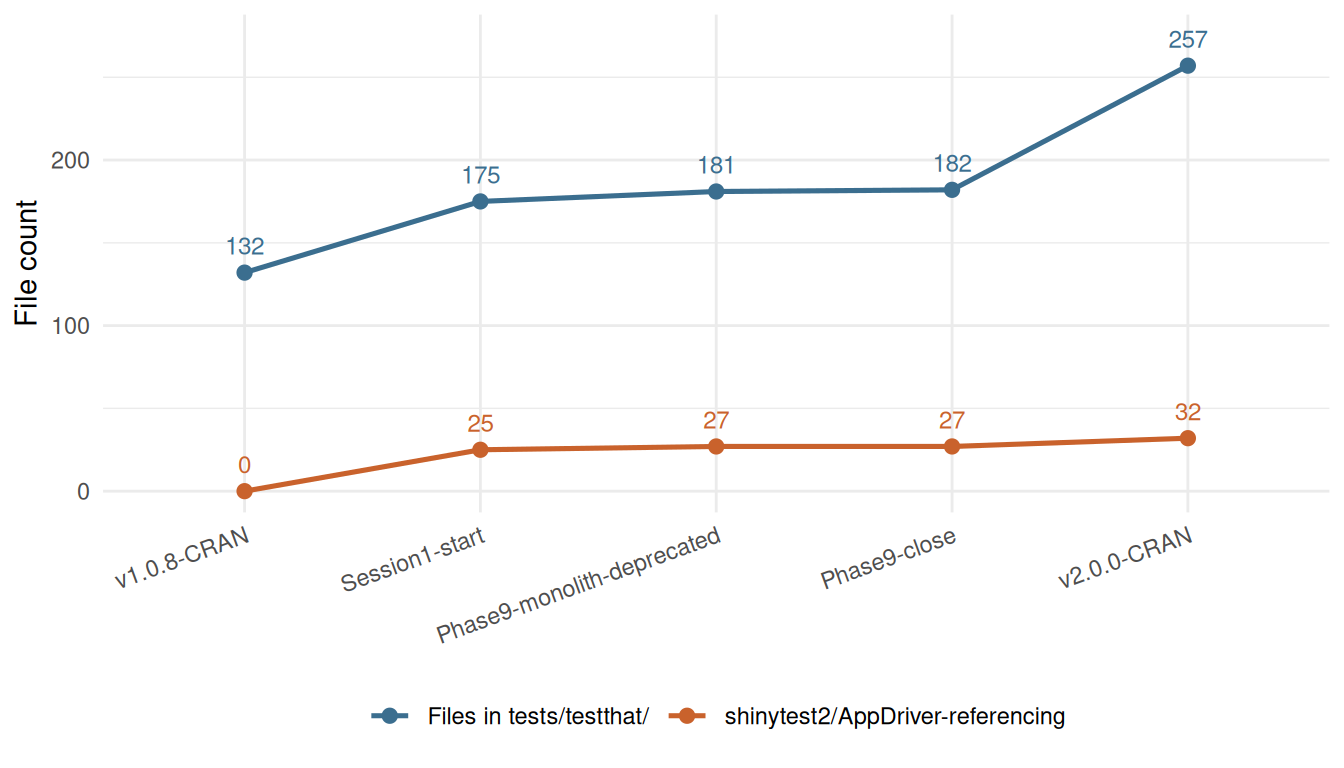
Growth in features (Section 4) is only as trustworthy as the tests behind it, and file-count growth by itself does not establish that – more files can mean more tests, deeper coverage, or simply more end-to-end scaffolding. Across the same v1.0.8 -> v2.0.0 range, the test suite grew from 132 to 257 .R files under tests/testthat/ – test files plus the shared helpers, fixtures, and setup script that support them – a 95% increase against a 512-commit range that itself roughly doubled the package’s feature surface. Two further numbers make the coverage claim itself, not just the file count, load-bearing: test_that() case count grew 283 -> 1,567 (454%, steeper than the file-count growth – files also got denser with assertions, not just more numerous), and Codecov’s recorded line coverage for the exact CRAN-submission commits rose 88.62% -> 99.70% (Table 4; source: the Codecov API’s per-commit report, api.codecov.io, queried 2026-07-11). More consequential than any of the three counts, though, is what changed in kind: a substantial browser-driven, end-to-end test harness went from present-but-inert to executable, and then from executable-but-shallow to exercising real data-bearing workflows.
Table 4 and Figure 3 ground the growth claim in five checkpoints rather than just the two endpoints: the v1.0.8 CRAN submission (4548aa1b, 2025-07-25, before this project adopted the SESSION_RUNNER methodology), the start of Session 1 (6fd87749, 2026-05-30), the two commits bracketing Phase 9 of the module migration (Section 3), and the v2.0.0 CRAN submission (8ca8bb24, 2026-07-09). The shinytest2/AppDriver-referencing count is already 25 files at Session 1’s start – that scaffold predates this project’s methodology entirely; it was built on the module branch (commit 7da01afe) during the same pre-Session-1 work that produced the modular app itself, but, as the next section describes, it did not run.
Coverage, unlike the file and test-case counts (both derived directly from git history), is not reconstructable at all five checkpoints: Codecov’s per-commit API (api.codecov.io/api/v2/github/rmsharp/repos/nprcgenekeepr/commits/<sha>/) returns a 404 for the three intermediate commits – no coverage report was ever recorded under those exact shas, for reasons this session did not trace further. Both CRAN-submission endpoints do have a recorded report, which is what the 88.62% -> 99.70% figure above cites.
From a dormant scaffold to an executable, hardened harness
A shinytest2 browser end-to-end suite existed in the tree from early in the module migration, but it did not work: the driver helper functions its 23 test files called – create_app_driver(), navigate_to_tab(), get_html_safe(), and four others – were never defined. Every call would have thrown “could not find function” if the suite had run; instead, an opt-in gate added at Session 19 (create_test_app()) made it skip cleanly by default, so the gap was invisible rather than failing loudly. Issue #39 tracked closing it.
A Session 30 planning pass found the gap was larger than the parent migration plan’s Phase 8 had assumed – 6 undefined helpers plus one undefined constant, not the 3 the plan named – and decomposed the work into a four-session sub-plan (docs/planning/phase8-e2e-harness-subplan.md, sub-phases 8a-8d, Session 31-34). 8a defined the helpers browser-free; 8b proved Chrome and the modular app itself would boot under shinytest2, the first-ever browser run, and rewired CI to run the suite on a nightly schedule plus manual dispatch rather than per pull request (browser tests are slower and more flake-prone than the existing fast unit CI, which remained the per-PR gate); 8c and 8d brought the remaining 20 files to green-or-clean-skip. Issue #39 closed at the end of Session 34 (2026-06-06) on the sub-plan’s own explicit completion bar: executable and CI-green opt-in, not behavioral validation.
That bar was deliberate, not an oversight. The sub-plan documented, in the same session that closed #39, why an executable suite does not by itself mean the suite validates behavior: navbarPage renders every tab’s static markup into the DOM at boot, hidden by CSS, so the suite’s dominant pattern – navigate to a tab, then grepl() a keyword against the whole page body – passes once the app merely boots, regardless of which tab is actually selected. Coverage at the end of 8d was boot-level. A follow-on issue, #40, was filed at that same session to close that specific gap.
Closing #40 took a further seven-slice pass (8e-1 through 8e-7, Session 37-50, 2026-06-07 to 2026-06-10) that replaced boot-level expect_true(TRUE) tautologies – 41 of them, suite-wide – with assertions tied to the actually-selected pane, fixed a wrong-tab navigation defect in the Summary Statistics family (7 of 8 tests targeted “Genetic Value Analysis” instead of their own tab), and, in its last three slices (8e-6a/b/c), rewired the pedigree-upload, Genetic Value Analysis, and breeding-group E2E blocks to drive the package’s real analytical pipelines end to end rather than asserting against static markup. A final slice, 8e-7 (Session 50), addressed an operational flake rather than a behavioral gap: running all 23 files in one CI process had produced roughly one transient Chrome/driver error per five full-tier runs; partitioning the run into 13 per-module groups, each a fresh R process, capped any single process at three files. Issue #40 closed the following day, 2026-06-11.
As of 2026-07-09, both issues are closed and the harness the sub-plan describes is the one currently checked in: .github/workflows/shinytest2.yaml runs nightly (07:00 UTC) and on manual dispatch, opts every test in via NPRC_RUN_E2E, and runs the per-module partition 8e-7 added – distinct from R-CMD-check.yaml and test-coverage.yaml, which remain the fast, per-pull-request gate. That partition was exact against the 23 test-{app,e2e}-*.R files that existed when 8e-7 closed (2026-06-11), but was not kept current as the suite grew: two more E2E files were added afterward – test-e2e-potential-parents-module.R (Session 82, issue #48) and test-e2e-orip-module.R (Session 86, issues #47/#49), covering exactly the two new Shiny tabs Section 4 describes – without a matching group added to the workflow. By 2026-07-08 the opt-in tier held 26 files against 13 groups covering only 24 of them, and those two orphaned files never ran in CI.
Session 337 (2026-07-09) closed that gap under the same TDD discipline this section describes: a new regression test (tests/testthat/test_shinytest2_workflow_coverage.R) parses the workflow’s group array and asserts every tracked file matches exactly one group; two groups were added for the previously orphaned files; and the workflow’s header comment was rewritten to state the invariant without a hardcoded file/group count, so it cannot go stale the same way again. A live workflow_dispatch run confirmed the fix on real infrastructure – all 15 groups green, including the two new ones (run 29057393786, commit c5ccf69b).
Section 4 – An AI-Assisted Development Process
Sections 1 through 3 describe what changed between v1.0.8 and v2.0.0. This section describes how: every session in that work was directed by Claude Code (Claude CLI) operating under a written protocol – SESSION_RUNNER.md, SAFEGUARDS.md, and this package’s own CLAUDE.md – rather than open-ended prompting. Within the same 512-commit range as Sections 1-3, 328 numbered sessions (Session 1, 6fd87749, 2026-05-30, through Session 328, the exact v2.0.0-submission commit itself, 8ca8bb24) account for 502 of those commits; the other 10 predate the methodology – informal module-branch experimentation plus the framework’s own bootstrap commit (299060c0, 2026-04-02).
A written protocol, not open-ended prompting
Each session follows the same three-phase shape. Orient reads SAFEGUARDS.md and SESSION_NOTES.md, checks open GitHub issues, runs a project health dashboard (methodology_dashboard.py), and reconciles CHANGELOG.md/HANDOFFS.md against git log for any commit a prior session left unrecorded – then reports what it found and stops for direction; no work begins before the owner responds. Execute commits to exactly one deliverable per session (“1 and done”) and claims it in SESSION_NOTES.md/HANDOFFS.md before any technical work starts, so a session that crashes mid-task still leaves a trace. Close out evaluates the previous session’s handoff, self-assesses against a written score, records new learnings, writes the next session’s handoff, and appends a dated entry to CHANGELOG.md before committing. SESSION_RUNNER.md names the failure to do that last step “unrecorded action” – one of the named, numbered failure modes the protocol maintains (27 at the 2.0.0 freeze; 28 today), each added after a session was observed failing that specific way.
Strict TDD, gated by explicit confirmation
For production R code – not this article’s own drafting sessions, see below – CLAUDE.md’s Development Process Contract requires strict red-green-refactor TDD: RED writes only failing tests, no implementation code; GREEN writes the minimum implementation that passes them, no new functionality; REFACTOR improves structure with no behavior change, all tests still passing. Figure 4 diagrams the cycle. What makes it more than a style guideline is the enforcement mechanism: the assistant must declare its current phase at the top of every response, and every phase transition (PRE-RED->RED, RED->GREEN, GREEN->REFACTOR) is gated by a structured AskUserQuestion prompt – not a prose question – with a header of the exact form TDD: <FROM>-><TO>, an option spelling out the concrete next-phase actions and verification, and an explicit hold/alternative option. Skipping a phase, or writing implementation code during RED, is a declared protocol violation the assistant must acknowledge and correct.
This article’s own drafting sessions illustrate the exception rather than the rule: none touched R/ or tests/, so each declared TDD phase: N/A explicitly in every response instead of running the cycle against prose it does not apply to – a small instance of the same discipline extending to correctly scoping when a rule applies, not applying it uniformly regardless of fit.
Self-assessment and a durable correction ledger
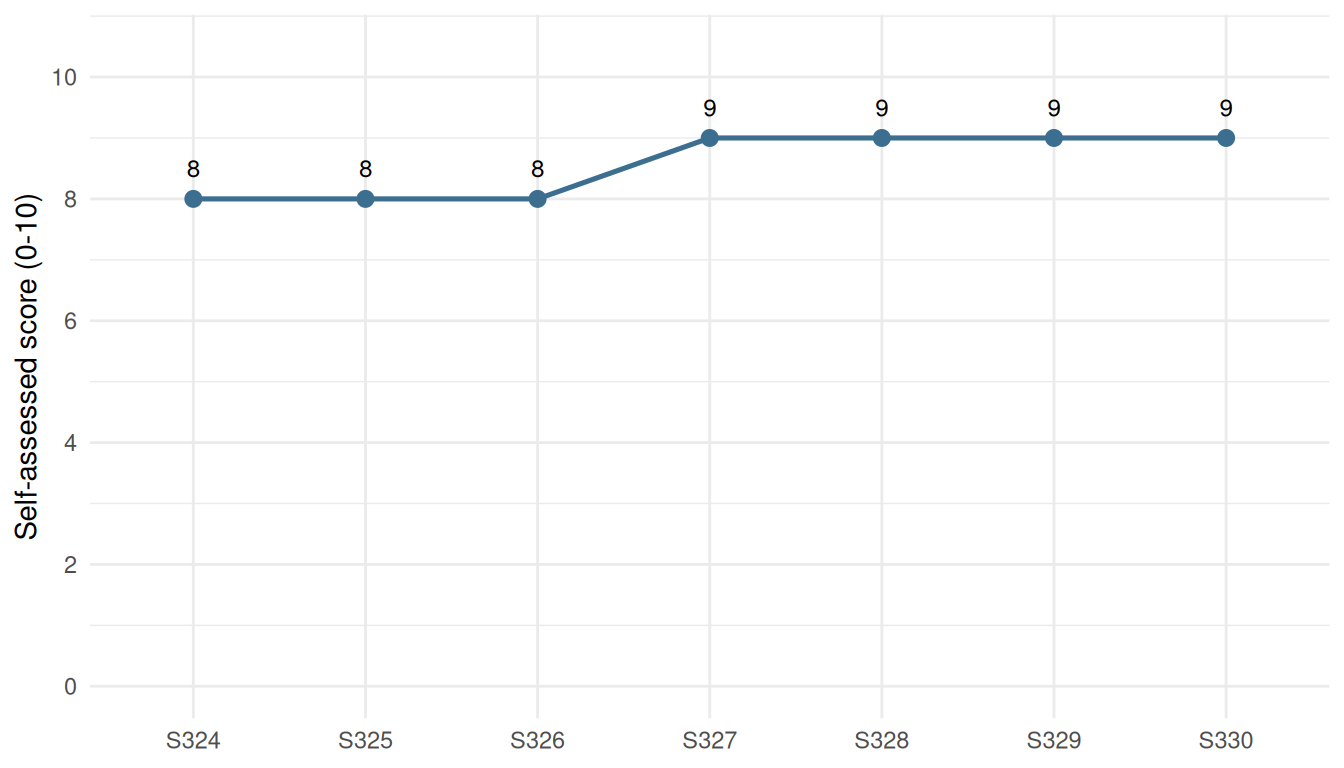
Figure 5 plots every complete HANDOFFS.md self-assessment score against session, for the sessions with one available.
The mechanism behind that self-scoring is a durable receipt, not a spoken summary: each session writes a HANDOFFS.md block recording what it did, what is next, key files, gotchas, and its own self_score. Separately, the next session reads that receipt and records its own predecessor_score for the handoff’s quality before starting its own work – two distinct numbers, not the same score computed twice – visible in Table 5 as 7 complete receipts against 328 sessions in range (the receipt requirement itself dates to Session 324). The same append-only discipline extends to CHANGELOG.md, and this article’s own drafting sessions are a live, verifiable example of it working: each of four consecutive sessions in this article’s drafting – the three that wrote Sections 1-3 plus the Phase A evidence-freeze session immediately before them – closed out with a commit: pending placeholder in its own HANDOFFS.md receipt (a session cannot know its own close-out commit’s sha before making that commit), corrected the placeholder with one small follow-up commit once the sha existed, and – because that follow-up commit landed after the session’s own CHANGELOG.md entry was already written – the following session’s Orient step caught and logged it in turn: cc0f7798 (Session 331’s fix, logged by Session 332), 2278b46f (Session 332’s fix, logged by Session 333), ee690776 (Session 333’s fix, logged by Session 334), and 5f0b81d2 (Session 334’s fix, logged by this article’s fifth session). Four consecutive sessions produced the same small gap; four consecutive Orient steps caught it.
PROJECT_LEARNINGS.md – 305 dated entries as of the same Phase A freeze, each naming a concrete finding, file, mechanism, and verdict, plus a glossary of named recurring reflexes cited by tag – is this project’s running record of what went wrong and what fixed it. SESSION_RUNNER.md maintains a parallel, numbered catalog of named failure modes (27 at the 2.0.0 freeze; 28 today) at the methodology level – among them “Eager to start” (skipping orientation), “Minimal handoff” (a technically-present but functionally useless handoff), and “Unrecorded action” (the gap the receipt-sha backfills above illustrates) – each added after a session was observed failing that way. Neither catalog is edited to remove an entry once a session outgrows it; corrections accumulate rather than get erased.
Table 5’s stakeholder-correction figures are the least precise numbers in this section, and are presented with that caveat rather than smoothed over: across SESSION_NOTES.md’s self-assessments, 269 explicit mentions report zero stakeholder corrections and 2 report exactly one – 99.3% zero, by mention count. That is a text-mention proxy, not an independently re-verified per-session audit; a session’s own self-assessment is not an external check on itself. Read it as “the sessions that stated a number mostly stated zero,” not as an audited defect rate.
Conclusion
The v1.0.8 -> v2.0.0 effort completed a modular Shiny rewrite – begun as an unfinished scaffold only months before this migration, not something the project carried for most of its life – and retired the monolith it replaced. Alongside that, it shipped thirteen curated new analysis capabilities, grew the test suite from 132 to 257 files while turning its browser-driven layer from present-but-inert into executable and behavior-verifying, and did all of it under a written, gated development process rather than ad hoc iteration.
For maintainers and collaborators, the practical implications are concrete. New features have exactly one Shiny implementation to extend, not two to keep in sync (Section 3). The R/mod*.R module boundary is now the unit of both development and testing (Section 3, Section 5). And the session-by-session record in CHANGELOG.md, PROJECT_LEARNINGS.md, and HANDOFFS.md is a navigable history of why each change was made, not just what changed (Section 6) – a resource future sessions, and future maintainers, can read directly rather than reconstruct from commit messages alone.
Work on this package up to and including version 1.0 was supported in part by NIH grants P51 RR13986 to the Southwest National Primate Research Center and P51 OD011092 to the Oregon National Primate Research Center.